

Many people notice their hearing seems perfectly fine in quiet settings but becomes frustratingly difficult in noisy restaurants. Conversations may sound muffled, voices may blend, and it can feel like everyone else is speaking clearly while certain words seem to disappear. This experience is one of the most common early signs of hearing difficulty.
Restaurants create a unique listening environment filled with background noise, overlapping conversations, and reflective surfaces that amplify sound. Even individuals with otherwise normal hearing can find these environments challenging. However, when speech consistently becomes hard to understand in noise, it may indicate changes in how the ears and brain process sound. Anne Arundel ENT & Facial Plastic Surgery serves patients in Annapolis and Severna Park who want to better understand why hearing in noisy environments becomes difficult and how hearing evaluations help identify these changes.
How the Brain Separates Speech From Noise
Hearing is not just about detecting sound—it also involves processing and organizing it. In everyday environments, the brain constantly filters out background noise to focus on important sounds, such as speech.
This ability is often called “speech-in-noise processing.” The ears capture all sounds in the environment, but the brain decides which sounds to prioritize. In a quiet room, this process is relatively simple. In a crowded restaurant, however, the brain must sort through multiple competing sounds at once.
When hearing and processing systems are working efficiently, the brain can separate speech from background noise. However, if hearing sensitivity or processing changes, distinguishing speech from noise becomes more difficult.
Why Restaurants Are Especially Challenging
Restaurants present several challenges that make hearing more difficult than in other environments. One major factor is background noise. Conversations from nearby tables, clinking dishes, music, and kitchen sounds all combine to create a constant layer of noise.
Another factor is sound reflection. Many restaurants have hard surfaces such as tile floors, glass, and walls that reflect sound rather than absorb it. This creates echoes that make speech less clear.
Multiple speakers also contribute to the difficulty. When several people are talking at once, the brain must decide which voice to follow. This can be especially challenging when voices overlap or when speakers are not directly facing the listener.
These conditions can make even simple conversations feel tiring or difficult to follow.
The Role of High-Frequency Hearing
Many early hearing changes affect the ability to hear high-frequency sounds. These sounds include consonants such as “s,” “f,” “th,” and “sh,” which are essential for understanding speech clearly.
In noisy environments, these high-frequency sounds are often the first to be masked by background noise. As a result, speech may sound muffled or incomplete. Words may seem unclear, even if the overall volume of speech is sufficient.
For example, a sentence may sound like it is missing certain sounds, making it harder to piece together the meaning. This is why individuals may say they can hear people talking but cannot understand what is being said.
Learning more about hearing loss can help explain how changes in hearing sensitivity affect speech clarity, particularly in noisy environments.
How Hearing Loss Affects Speech Clarity
Hearing loss does not always mean sounds are too quiet. In many cases, sounds may still be audible but lack clarity. This is especially noticeable in environments with background noise.
When the inner ear’s sensory cells are affected, sound signals sent to the brain may become less precise. This can make it harder to distinguish between similar sounds or separate speech from noise.
As a result, conversations in busy settings may require more effort to follow. Individuals may find themselves asking others to repeat themselves or relying on visual cues such as lip reading.
This type of difficulty is often one of the first signs of hearing changes.
Listening Effort and Mental Fatigue
Understanding speech in noisy environments requires concentration, even for individuals with normal hearing. When hearing becomes less efficient, this effort increases significantly.
The brain must work harder to fill in missing sounds and interpret incomplete information. This increased effort is sometimes referred to as listening fatigue.
After spending time in a noisy restaurant, individuals may feel mentally tired or overwhelmed. They may also find it difficult to keep up with conversations over extended periods.
This fatigue is not just about hearing—it reflects the extra cognitive effort required to process sound in challenging environments.
Why People May Not Notice Hearing Changes Right Away
Hearing changes often develop gradually, making them difficult to detect at first. Many individuals adapt to these changes without realizing it.
Because quiet environments remain manageable, people may assume their hearing is normal. It is often only in challenging situations—such as noisy restaurants—that difficulties become noticeable.
Friends or family members may notice these changes first, especially if conversations frequently need to be repeated.
Recognizing these early signs can help individuals better understand how their hearing may be changing.
When Difficulty Hearing in Noise Should Be Evaluated
Occasional difficulty hearing in noisy environments can be normal. However, consistent or worsening challenges may benefit from a hearing evaluation.
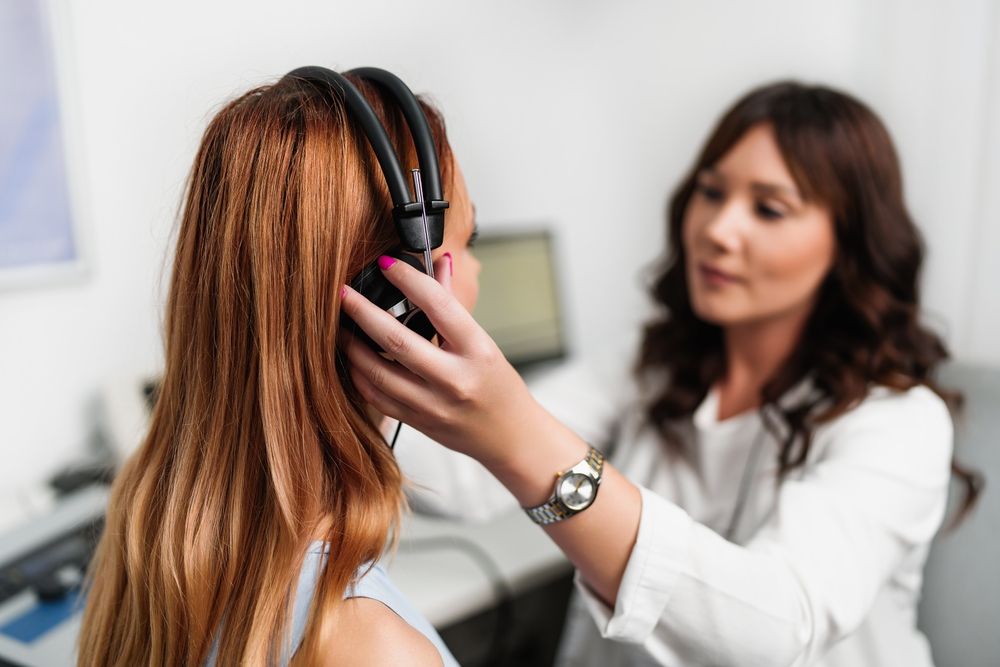
Audiologists use specialized tests to assess how well a person hears both tones and speech. Speech-in-noise testing may also be used to evaluate how effectively the brain processes speech in complex listening environments.
These evaluations provide valuable insight into hearing ability and help identify patterns that may not be noticeable in everyday situations.
Understanding the cause of muffled hearing is an important step in maintaining overall hearing health.
Everyday Strategies That May Help in Noisy Settings
While hearing challenges in noisy environments can be frustrating, certain strategies may help improve communication.
For example:
- Choosing quieter seating areas away from kitchens or speakers
- Sitting across from conversation partners to improve visual cues
- Reducing background noise when possible
- Taking breaks during long conversations
These adjustments may help make conversations easier to follow in busy environments.
Understanding Why Speech Sounds Muffled
Hearing in noisy environments requires coordination between the ears and the brain. When background noise increases, the brain must work harder to separate speech from competing sounds.
Changes in hearing sensitivity, particularly in high-frequency sounds, can make this process more difficult. As a result, conversations may sound muffled or incomplete, especially in places like restaurants.
Anne Arundel ENT & Facial Plastic Surgery serves patients in Annapolis and Severna Park who want to better understand why conversations sound muffled in noisy environments and how hearing evaluations help identify changes in auditory health.
Sources
Plomp, R. (1978). Auditory handicap of hearing impairment and the limited benefit of hearing aids. Journal of the Acoustical Society of America.
Humes, L. (2013). Understanding the speech-understanding problems of older adults. American Journal of Audiology.
Pichora-Fuller, M. K., et al. (2016). Hearing impairment and cognitive energy. Ear and Hearing.