

If you’re preparing for your first hearing test, it’s completely normal to feel unsure about what the appointment will involve. Many adults delay scheduling hearing evaluations simply because the process feels unfamiliar. In reality, a full audiology evaluation is noninvasive, comfortable, and highly informative—allowing you to understand your hearing health with clarity and confidence. This guide walks you through each step, helping you approach the experience with ease. Anne Arundel ENT & Facial Plastic Surgery in Severna Park and Annapolis provides educational resources for patients throughout the Baltimore region who want to better understand their hearing concerns.
Why a Hearing Evaluation Matters
Hearing changes often develop slowly, which is why many adults don’t notice them right away. You may catch yourself asking people to repeat themselves, turning up the TV, or struggling to hear in noisy environments. A full evaluation helps identify how your hearing compares across different frequencies and whether certain sounds are harder for you to detect.
For many adults, the first step toward understanding their hearing health begins with full audiology testing, which provides a complete overview of auditory function.
Step 1: Your Conversation With the Audiologist
Your visit begins with a discussion of your hearing history. The audiologist may ask:
• When you first noticed symptoms
• Whether hearing is harder in certain environments
• If you’ve had long-term noise exposure
• Whether you experience ear fullness, pressure, or ringing
Some individuals also describe sinus-related symptoms, such as pressure or congestion, that can temporarily affect ear comfort. If symptoms tend to worsen during certain seasons, educational resources on seasonal allergies may help clarify how allergies and hearing interact.
If your symptoms appeared suddenly or after an illness, your audiologist may explore whether structural concerns or injuries—such as a perforated or ruptured eardrum—could be playing a role.
Step 2: Otoscopic Ear Examination
During this step, the audiologist uses an otoscope to examine your ear canals and eardrums. They may check for:
• Wax buildup
• Redness or irritation
• Fluid behind the eardrum
• Signs of infection
If excessive earwax is limiting your hearing, educational information about cerumen and earwax removal can help you understand how buildup affects sound clarity.
Step 3: Middle Ear Function Testing
Next, tympanometry may be performed to evaluate how your eardrum responds to slight pressure changes. This helps determine whether fluid, congestion, or middle-ear stiffness is affecting your hearing.
Some individuals experiencing chronic sinus pressure or facial discomfort may find it helpful to review educational material on sinus headaches, as sinus and ear pressure often influence one another.
Step 4: Pure-Tone Audiometry
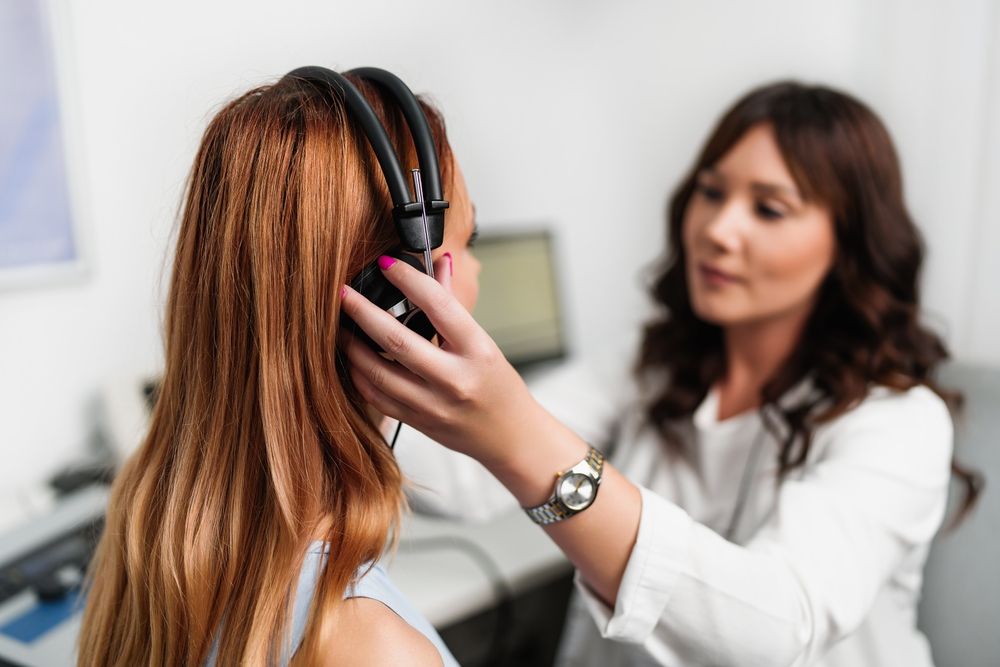
This portion of the evaluation takes place in a quiet, soundproof booth. You’ll wear headphones or ear inserts and listen for soft beeps at different pitches. You simply press a button or raise your hand when you hear a sound.
Pure-tone testing identifies:
• Which frequencies you hear well
• Where hearing is reduced
• Whether both ears respond similarly
Your responses form an audiogram—a chart that visually represents your hearing thresholds.
Step 5: Speech Audiometry
Because communication relies on understanding speech—not just hearing tones—your audiologist will also conduct speech recognition tests. You will be asked to repeat words played through the headphones at various volumes.
This helps determine:
• How clearly you understand speech
• Whether certain speech sounds are hard to distinguish
• Whether clarity issues relate to volume or processing
If results indicate changes in clarity, it may be helpful to learn more about the broader symptoms of hearing loss to understand how these patterns affect daily communication.
Step 6: Reviewing Your Results
Once all testing is complete, your audiologist will review your results in detail. You’ll see how your hearing compares to typical ranges, where any changes may be occurring, and how those results relate to your real-world listening experiences.
This final discussion also allows you to ask questions about:
• Long-term hearing monitoring
• Communication strategies
• Situational listening challenges
• Ways to protect your hearing going forward
Your results become a roadmap for understanding your hearing wellness—not just today, but over time.
How to Prepare for Your Evaluation
Good preparation can help ensure the most accurate results. Consider the following:
• Avoid loud noise for 24 hours before your test
• Make note of specific hearing challenges you’ve experienced
• Bring a companion if you want help remembering information
• Avoid inserting cotton swabs or objects into your ears beforehand
An audiology evaluation is a positive first step toward understanding how well your ears detect and process sound.
What Happens After Your Appointment
What comes next depends on your results. Some individuals need only routine monitoring, while others find that their symptoms reflect early hearing changes that can benefit from personalized communication strategies. Some may also learn that sinus or congestion patterns contribute to ear pressure or fluctuating symptoms.
Regardless of the outcome, the goal of your visit is clarity—helping you understand your hearing health with confidence.
Conclusion
A full audiology evaluation is a straightforward, informative experience designed to give you a clear picture of your hearing wellness. By understanding each step of the process, you can approach your appointment feeling comfortable and prepared. Anne Arundel ENT & Facial Plastic Surgery in Severna Park and Annapolis offers educational guidance to help individuals throughout the Baltimore region make informed decisions about their hearing health.
Sources
American Academy of Audiology (2021). Audiologic Guidelines for the Assessment of Hearing.
Gates, G. A., & Mills, J. H. (2005). Presbycusis. The Lancet.
Wilson, R. H. (2011). A review of speech audiometry. Journal of the American Academy of Audiology.